
Valley Release Date Milestones
A projected date is a forecast or legal milestone. An actual release date is the timestamp when custody ended or changed through a documented transfer. For Idaho prison cases, the public IDOC detail can show a Parole Eligibility Date, Released to Supervision, and Sentence Satisfaction Date. The Commission may publish a tentative parole date after a grant. Each field answers a different question.
Scheduled is not actual. A tentative parole date can depend on programming, an approved parole plan, and complete paperwork. The Commission states that nobody is released before the reflected tentative date, but the grant does not prove release on that date. Confirm the later IDOC movement or Released to Supervision entry.
A pretrial detainee usually has no fixed sentence-release date. Release may depend on bond, a court order, dismissal, or transfer. A local sentence can have an expected end after court-awarded jail credit, yet another warrant or detainer may prevent community release.
Find Valley County Release Dates
- Identify the system. Ask whether the person is at the Valley County Detention Center, an IDOC institution, federal custody, or another agency.
- For an IDOC case, use the Resident/Client Search. Search by last name or IDOC number, open the matching detail, and read every date label.
- For a Valley County jail sentence, obtain the judgment through Idaho iCourt or the Valley County clerk. Confirm the court's credit for time served and any consecutive terms.
- Ask the Detention Center for its existing release calculation and, after the event, the actual release timestamp. The jail number is 208-382-7168; records is 208-382-7173.
- Check the Commission action when parole is involved. Match the IDOC number.
- Check for other holds. A detainer is another agency's request to keep custody or arrange transfer.
- Use the final movement, release, or discharge record to replace any earlier estimate.
The Valley County released-inmate record guide explains how to request the sheriff's release event after the person leaves.
Idaho Dates Are Not 85 Percent
Idaho should not be described with a blanket rule that every state prisoner serves 85 percent of the announced sentence. Idaho Code §19-2513 establishes the unified sentence. A judgment states a fixed minimum term followed by an indeterminate term. During the fixed part, ordinary parole, discharge, or good-conduct reduction is unavailable, subject to narrow statutory exceptions. Idaho Code §20-223 governs Commission authority and eligibility, but it is not the sole arithmetic for the first eligible date.
The Parole Eligibility Date usually marks the earliest possible parole point, when the indeterminate portion begins. With more than one sentence, the latest relevant indeterminate start can control the displayed eligibility concept. Eligibility is not a promise. The Commission retains discretion, and offense-specific minimums, life terms, consecutive sentences, or the judgment itself may delay or remove eligibility.
Federal discussions about an 85-percent service rule do not control an Idaho sentence. Neither do formulas from other states. Read the Idaho judgment and current agency calculation.
Valley Good-Time Rules Corrected
Modern Idaho cases do not receive a routine daily or monthly credit merely for ordinary good behavior. Idaho Code §20-101A's ordinary monthly deductions apply to offenses committed before July 1, 1986. It must not be used as a current universal calculator.
For post-1986 offenses, Idaho Code §20-101D allows a director-awarded reduction of no more than fifteen days per month sentenced for extraordinary meritorious service. The statute describes rare acts such as heroism at risk of life, saving life or preventing major property loss in a riot, or preventing escape. Program attendance and rule compliance are not the same award.
Court-ordered jail credit, retained-jurisdiction credit, amended judgments, parole forfeiture, and concurrent or consecutive terms affect calculations in distinct ways. IDOC Sentencing Records reviews judgments, applies credits, maintains calculations, and coordinates with courts and jails. Its JustFOIA portal is the proper route for an existing calculation when the displayed date is disputed.
What Changes Valley Release Dates
| Factor | Possible effect | Record to check |
|---|---|---|
| Amended judgment | Changes term structure or court credit | Signed court order and IDOC recalculation |
| Consecutive sentence | Moves eligibility or satisfaction later | Judgments and sentence calculation |
| Parole grant or denial | Creates a conditional tentative date or leaves the term in force | Commission Notice of Action |
| Program or plan approval | Can delay a tentative parole release | Commission and IDOC case record |
| Warrant or detainer | May produce continued custody or transfer | Holding and receiving agency records |
| Extraordinary credit | Rare statutory reduction if formally awarded | IDOC sentence computation |
| Administrative lag | Online detail may trail a fast change | Direct agency confirmation |
IDOC says its public database is updated daily, yet location, status, and scheduled termination information can change too quickly for immediate display. A stale date is a reason to verify, not a basis to recalculate it privately.
Read Valley IDOC Date Fields
The IDOC form uses Last Name, First Name, and IDOC Number. Last name or IDOC number is required. Partial queries can use the first two characters of a last name or first three digits of the number. Always open the individual detail because a result list does not explain every milestone.
A Valley-sentenced public example reviewed in the research showed Status: In community, a Valley County row marked Parole, a Released to Supervision date, and a later Sentence Satisfaction Date. That example demonstrates the fields, not anyone's current situation. IDOC defines Released to Supervision as the date most recently placed on supervision by a court or the Commission. The supervising district can differ from Valley County because assignment follows the approved residence.
The official search page provides the live fields:
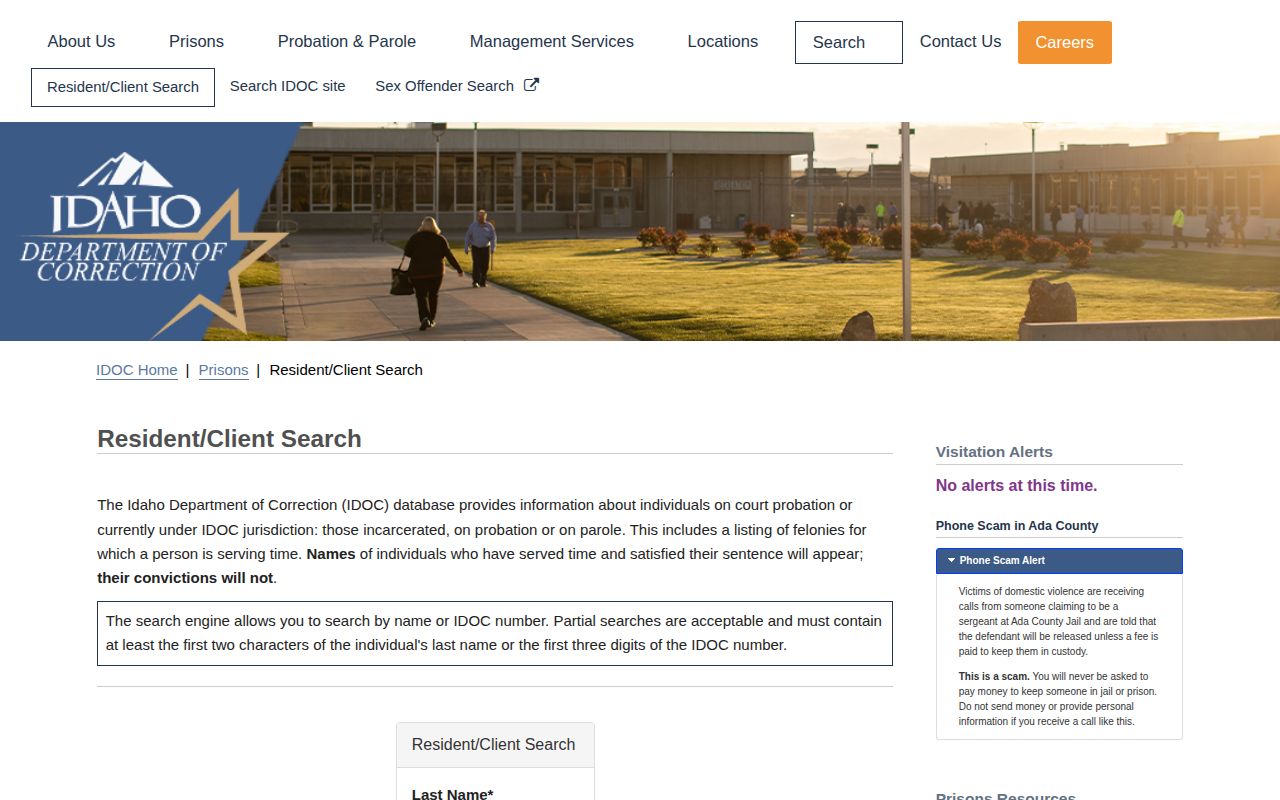
Use the form to identify the record, then verify a disputed date with Sentencing Records.
Valley County Jail Calculations
For a local sentence, obtain the Valley County judgment and verify each day of court-awarded credit. Ask the jail for its calculation and check for another hold. No official Valley County good-time formula, general release hour, weekend rule, holiday early-release policy, or bond-posting procedure was found. Administrative office hours do not limit when the jail operates and do not predict when a release will occur.
Do not promise a Friday release merely because an expected date falls on a weekend. Do not treat a planned court-commit end as the event record. People ordered to court-commit or work-release time must sign up with the Detention Center before reporting, but the later jail release entry confirms completion or exit.
Valley Release Paths by Custody
A bond case has no sentence arithmetic to perform. The court sets the legal terms, but the jail records when approval is complete and custody changes. A dismissal can support release while another case or outside hold keeps the person confined. Time served means the court credited enough custody to satisfy the imposed jail term; the actual exit still belongs in the jail record.
A transfer is also not community release. IDOC can list Valley County Jail as the physical location of a state client and direct location questions to the local agency. Conversely, disappearance from a local list can mean movement to an IDOC institution rather than freedom. Search the statewide system without limiting the inquiry to a prison physically in Valley County, since no IDOC prison was identified in the county.
Federal and immigration dates require different sources. The BOP locator can display a past release date, a projected future date, or UNKNOWN when release information has not been determined. Those fields apply only to federal BOP records. ICE's locator can include people released from ICE custody within the prior sixty days, but that limited trail does not prove a Valley County jail event. Match identifiers and jurisdictions before combining records.
Valley Date Record Requests
A useful request asks for an existing record rather than a fresh calculation. For the sheriff, identify the person and booking, then request the booking and release timestamps, release type, authority, and transfer or detainer disposition when maintained and public. Use the sheriff's written form and ask for electronic delivery plus an estimate before paid work.
For IDOC, provide the IDOC number and Valley County case. Ask Sentencing Records for the public sentence calculation, movement or release record, Released to Supervision entry, and sentence-satisfaction or discharge document. Commission hearing minutes and non-online actions go to the Commission's public-information route. Court judgments go through the clerk and judicial-record process, not the sheriff form. These offices hold different records, so one broad county request will not retrieve every state or court document.
Confirm Actual Valley County Release
After a state release, compare the Commission notice with the later IDOC Released to Supervision or movement record. After a county release, request the sheriff's existing booking and release record, including timestamp, release type, authority, and transfer destination when maintained and public. Pair it with the court order if the legal disposition matters.
VINE can provide a timely custody-change alert, but it relays participating-agency data and is not a certified record. The VINE Inmate Check explains the one-person search and registration path. An alert should trigger direct sheriff or IDOC confirmation. Final discharge may require a Gold Seal or other formal notice, not merely a projected date passing.
Search Public Records
Sponsored Results