
Valley County Parole or Probation
Parole follows a prison sentence. The Idaho Commission of Pardons and Parole decides whether an eligible person may serve part of an indeterminate sentence in the community. Probation is ordered by a court, often instead of prison or after a retained-jurisdiction case returns to court. IDOC supervises state felony parole and probation clients, but the Commission does not decide probation.
Valley County Court Services adds another local layer. It handles local pretrial monitoring and misdemeanor or adult probation. Pretrial release means a case is still pending under court-set conditions. It is not parole, sentence completion, or final discharge. The judgment, IDOC record, and court docket show which form of oversight applies.
| Status | Who orders it | Best verification |
|---|---|---|
| Parole | Idaho Commission after prison eligibility | IDOC client detail plus Commission action |
| Felony probation | Sentencing court | Judgment and IDOC supervision detail |
| County probation | Local court | Valley County court record and Court Services |
| Pretrial monitoring | Court before disposition | Current docket, bond order, and Court Services |
Verify Valley County Supervision
Start with identifiers, not a name alone. An IDOC number is strongest for a state client. Date of birth, middle name, Valley County case number, and offense details help separate people with similar names.
- Search the official IDOC Resident/Client Search. It accepts Last Name, First Name, and IDOC Number. A last name or IDOC number is required, and partial searches need at least two last-name letters or three IDOC digits.
- Open the correct detail and read Status, Supervising District, Parole Eligibility Date, Released to Supervision, and Sentence Satisfaction Date separately. IDOC says its database is updated daily, but fast changes may lag.
- For parole, match the IDOC number against the Commission decisions. A grant or tentative date is not proof of physical release.
- Check the Idaho court record for the judgment, probation order, violation filing, or discharge. Search party names as LASTNAME, FIRSTNAME in iCourt.
- Call the listed supervision office when the assignment or current standing is unclear. Reporting instructions are personal and should not be guessed from the sentencing county.
The full Valley County released-inmate search path explains how the jail record, court disposition, and IDOC movement entry prove different parts of the release.
District 4 Supervises Valley Releases
Valley County lies in Idaho's Fourth Judicial District. State parole and felony probation therefore route through IDOC District 4, not District 3 offices in counties immediately west. The District 4 page identifies a McCall satellite office at 106 Park Street, Room 104, McCall, Idaho 83638, phone 208-634-0018. The main District 4 office is at 10221 W. Emerald Street in Boise, phone 208-327-7008.
This local office is a useful contact, but it does not prove that every Valley-sentenced person reports in McCall. Supervision can follow an approved residence or assignment elsewhere. Read the live Supervising District field, then ask that district which office owns the case. Do not direct a person to appear without checking their written reporting instructions.
The official District 4 source shows the offices and contact route:
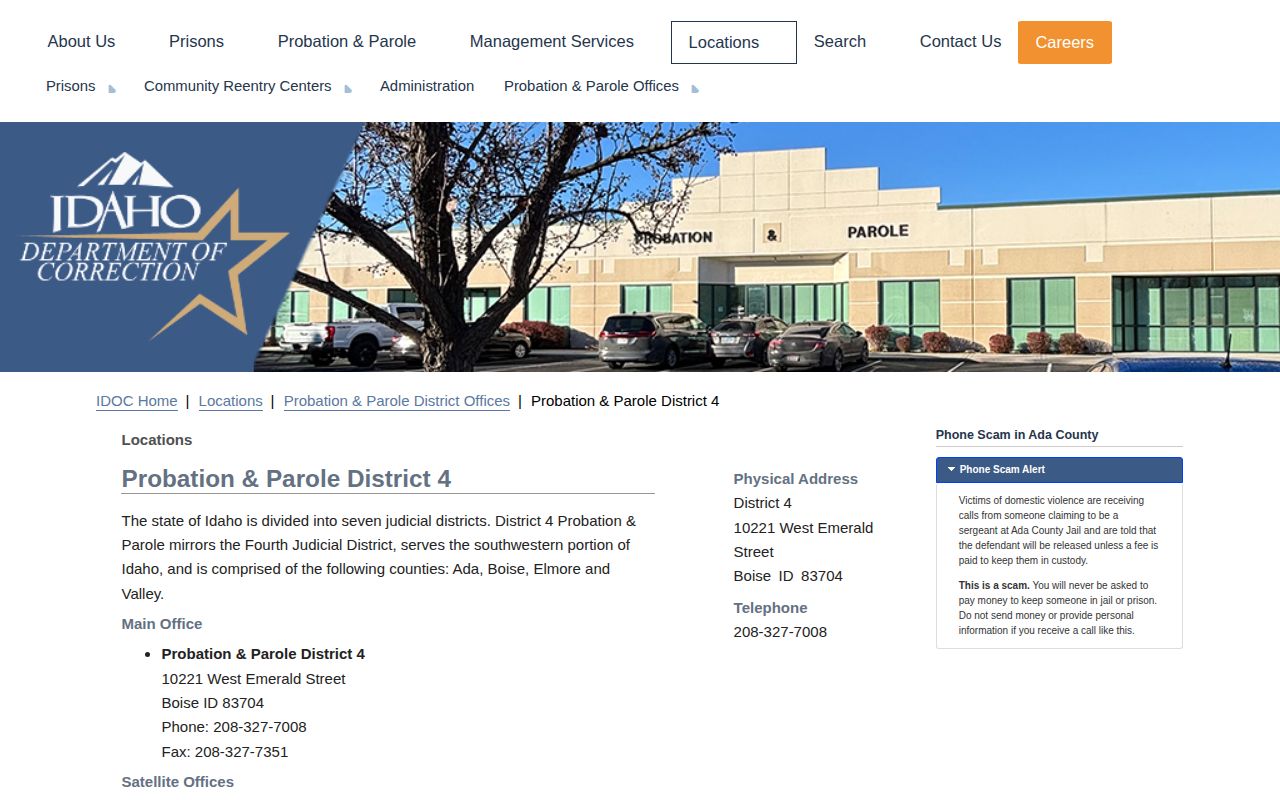
The district listing is the proper starting point for office verification, while the individual IDOC record controls the supervising district.
Valley County Parole Hearings
The Idaho Commission publishes weekly hearing schedules. Dates and times can change. Agendas may include regular parole and revocation matters and list the name with an IDOC number. Match that number because a name alone is not enough.
Results appear on the Commission's decisions page, generally through a Notice of Action Taken after the hearing. Outcomes can include granted, denied, passed or deferred, reconsidered, rescinded, and revocation-related action. Each term has its own effect. A parole grant creates a tentative date subject to required programs, an approved plan, and final paperwork. It does not mean the person walked out that day. A revocation matter concerns someone previously on parole who may have returned to custody.
Idaho Code §20-223 supplies key Commission authority and eligibility rules. There is no right or presumption of parole. The judgment, offense limits, life terms, and consecutive sentences may alter eligibility.
Valley Supervision Status Terms
Key terms. A parolee serves part of a prison term under community rules. A probationer follows court-ordered conditions. An absconder is alleged to have stopped reporting or left supervision without approval. A detainer asks one agency to hold a person for another. Discharge ends the sentence or supervision authority; release from a jail building does not necessarily do so.
IDOC may show a warrant or supervision concern, but the research found no official Valley County warrant or absconder list. Do not infer an active warrant from a missed appointment, an old news item, or a stale directory. Confirm urgent status with the supervising agency or the court that issued the order.
Conditions often address reporting, residence, travel, treatment, contact, and compliance with law, but each order differs. A suspected violation does not itself establish revocation. Officers investigate, courts handle probation matters, and the Commission handles parole matters through their respective processes.
When Valley Supervision Ends
Released to Supervision and Sentence Satisfaction Date are not synonyms. The first records the latest placement under court or Commission supervision. The second is a sentence milestone. Actual discharge should be proved with the final agency or court document.
The Commission says the formal discharge notice commonly called a Gold Seal is sent to the person's last supervision district for forwarding and may take up to a month. That document is stronger proof of final discharge than an active row disappearing or changing online. IDOC also notes that people who served and satisfied an IDOC sentence can remain searchable by name even though satisfied convictions no longer display. Online presence alone therefore does not mean active supervision.
For a disputed calculation or missing release record, IDOC Sentencing Records maintains sentence calculations, applies court and retained-jurisdiction credits, processes parole forfeiture, and works with courts, jails, and the Commission. Request the existing calculation through the linked IDOC records route rather than asking an office to give legal advice.
Valley County Records Cross-Check
No single screen supplies the whole post-release story. The sheriff record proves when a person left the Valley County Detention Center or transferred. The judgment establishes the sentence and any probation order. IDOC identifies a state client's status and assigned supervision district. The Commission notice supplies a parole decision. When the records conflict, compare their event dates and ask the office responsible for the disputed field.
iCourt is useful for this cross-check. The official search tutorial directs users to enter a party as LASTNAME, FIRSTNAME; first-name-first can return no result. A public case detail may contain bond information, disposition events, hearings, and the register of actions. Some sealed or exempt cases simply return no results. That result does not prove no case exists. Idaho Court Administrative Rule 32 controls judicial access, so request a certified order from the Valley County clerk when remote access is unavailable or formal proof is needed.
VINE serves a narrower role. It can send a custody-change notice based on participating agency data, but it does not certify that parole began or that probation ended. Treat an alert as a prompt to check the sheriff, IDOC, court, or Commission record.
Property After Valley County Release
Valley County has a distinct property route that can be confused with supervision. The Sheriff's Property Request form concerns items held by the Evidence and Property Division. Release can depend on the type of item, case status, and proof of purchase. That process is different from routine personal property returned by detention staff when a person leaves jail.
No public local procedure for ordinary inmate-property return was found. Call the Valley County Detention Center first. Use the evidence form only when staff confirm that the Evidence and Property Division holds the item. A supervision officer may help explain a condition, but does not replace the sheriff's custody of evidence.
Keep the property issue separate from reporting duties. Waiting for an item does not extend a parole deadline, change a probation term, or excuse a missed report unless the supervising office gives specific direction. Preserve receipts, form confirmations, and the name of the agency holding the item. Those details make a later follow-up precise without mixing evidence custody into the supervision record.
Search Public Records
Sponsored Results